The Denard currency during the Roman Republic period
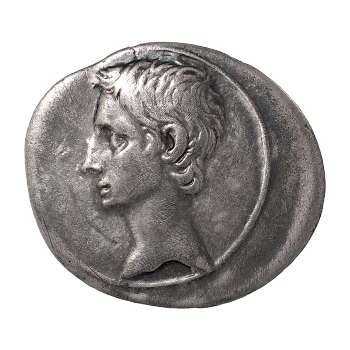
The Denard currency during the Roman Republic period

Denarius is an ancient Roman silver coin that was first introduced around 211 BC. Widely used during the Roman Republic and Roman Empire, it became the main currency unit at that time. Octavianus, later known as Augustus, was the first emperor of the Roman Empire and ruled from 27 BC to 14 AD. On the Denard coins issued between 44 BC and 27 BC, his portrait and various symbols of Roman power and victory were usually engraved.
Roman currency Denar

Roman currency Denar

Denarius is an ancient Roman silver coin that was first introduced around 211 BC. Widely used during the Roman Republic and Roman Empire, it became the main currency unit at that time. Octavianus, later known as Augustus, was the first emperor of the Roman Empire and ruled from 27 BC to 14 AD. On the Denard coins issued between 44 BC and 27 BC, his portrait and various symbols of Roman power and victory were usually engraved.
Roman currency Antoninian

Roman currency Antoninian

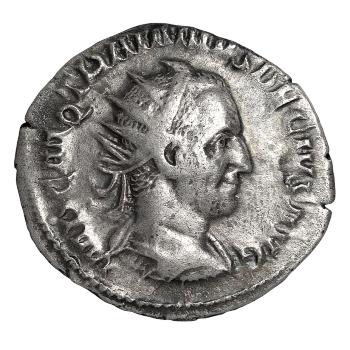
Antoninianus is a silver coin from the Roman Empire period, introduced by Emperor Caracalla in 215 AD. Although its face value is two Denarius, its weight is much lower than that of two Denarius. Antoninian initially contained about 49.5% silver, but over time its silver content continued to decrease, reaching only 2.5% silver by 274 AD.
Lucius relief bust

Lucius relief bust

This Roman stone tomb relief depicts Lucius Antius Philomorsus, his daughter, and his wife. The relief is depicted in the style of the Roman Republic. The production date of this work is from 15 BC to 5 AD, and the dimensions are: height of 61 centimeters, width of 165 centimeters, and depth of 18.5 centimeters. This relief is currently housed in the British Museum.
Roman marble statue of Hera Borgese

Roman marble statue of Hera Borgese

This statue represents the goddess of love Aphrodite, originating from MonteCalvo in the 2nd century AD, and is currently housed in the Nie Karlsberg Sculpture Museum in Copenhagen, Denmark. This sculpture is a Roman marble replica of a classical Greek bronze statue.
Marble bust of Emperor Grommacus Aurelius

Marble bust of Emperor Grommacus Aurelius

The height of this bust is 73.66 centimeters. Marcus Aurelius (April 26, 121 AD - March 17, 180 AD) was an emperor of the ancient Roman Empire who reigned from 161 AD to 180 AD. He was a philosopher of the Stoic school, known for his philosophical ideas and the book "Reflections". He was also a member of the Nerva Antony dynasty, hailed as the last of the five good emperors and the last emperor of the Roman Empire's peaceful era (27 BC to 180 AD). This statue is currently housed in the British Museum.
Roman Emperor Caracalla marble bust

Roman Emperor Caracalla marble bust

Caracalla was an emperor of the Roman Empire who reigned from 198 to 217 AD. He is known for his strict and cruel way of ruling. This bust has a height of 67.50 centimeters and was discovered at Quattro Fontane on Quirinal Hill in Rome. It is now on display in Gallery 70 of the British Museum.
Ancient Roman Antinos Head Marble Statue

Ancient Roman Antinos Head Marble Statue

The head of this marble statue was taken from a statue of Antinos, who was wearing an ivy wreath. The bust was added later, with the head fixed on top. The head of this statue dates back to the Roman period and was made around 130-140 AD. It was excavated on the Janiculum Mountain in Rome, Lazio, Italy, in Europe. The height of the head of this statue is 81 centimeters and it is currently housed in the British Museum. Antinos was the boyfriend or lover of Roman Emperor Hadrian.
The Roman Limestone Coffin from the Ancient Roman Empire Period

The Roman Limestone Coffin from the Ancient Roman Empire Period

This Roman limestone sarcophagus was discovered in Hayden Square, London. It was made in the 4th century AD, during the period of the Roman Empire. This sarcophagus is now preserved in the British Museum in London.
The marble statue of the Byzantine Empire in ancient Rome, known as the "Marble Maiden Statue"

The marble statue of the Byzantine Empire in ancient Rome, known as the "Marble Maiden Statue"

This artifact is a small Eastern Roman marble statue depicting a young girl. Its production date is around 525 BC to 500 BC, and the statue is made of marble. The posture and attire of this young girl statue are the same as the famous Kore statue found in the Acropolis of Athens. Her left leg moved slightly forward, and her left hand grabbed her thin linen jacket, pulling it tightly over her leg; The right hand may have once held an offering. Her short cloak slanted over her right shoulder and then hung down from her left arm, forming vertical, stacked folds. The surface of the statue becomes vivid due to the variations in clothing layers and textures.
Fragment of a statue from the Gallic Roman period titled 'The God of Ophigny'

Fragment of a statue from the Gallic Roman period titled 'The God of Ophigny'

This is a fragment of a limestone statue, known as the god of Ophiene, with a pig image on it and a twisted necklace around its neck. The fragments were made during the 1st century BC, Roman Empire period, and Gaul Roman period (58 BC -5th century AD). This fragment was discovered in Ophiene. The fragments are made of limestone. The dimensions of the fragments are: height of 25.8 centimeters, width of 10.5 centimeters, and depth of 7.5 centimeters. The fragments are now collected at the National Archaeological Museum in London.
The marble statue of Apollo from the Hellenistic period of ancient Rome

The marble statue of Apollo from the Hellenistic period of ancient Rome

This marble statue is Apollo, holding a qin and quiver in his hand. He was naked except for the cloak around his waist. The right arm that was originally raised, as well as the left wrist and hand, are now missing. This statue is a work from the Hellenistic period of Rome, made in the 2nd century AD. This statue was excavated by an archaeological team led by Sir Robert Murdoch Smith and Edwin A. Borcher at the Temple of Apollo (Cyrene) in Libya. Now, this statue is housed in the British Museum in London. The height of the statue is 2.28 meters. This statue is a Roman replica of the original Greek work dating back to 200-150 BC.
The marble statue of Roman women from the ancient Roman Empire period, known as the "Roman Female Bust"

The marble statue of Roman women from the ancient Roman Empire period, known as the "Roman Female Bust"

This statue is currently housed in the National Archaeological Museum of Umbria, located in San Domenico, Italy.
Roman Empire period marble statue "dance muse"
Roman Empire period marble statue "dance muse"

This marble statue is the work of ancient Rome in the 2nd century AD and is now in the museum in Copenhagen, Denmark. The rotation movement emphasized by the right hand holding the cloak indicates that the woman is dancing. She's the muse, the muse of dance. The muse in Greek mythology is the muse of sacred poetry, sacred hymns, dance and eloquence, and agriculture and pantomime. She is depicted as very serious, contemplative and meditative, often putting her fingers to her mouth, wearing a long cloak and veil, and resting her elbows on a post. It is also sometimes considered the muse of geometry and meditation. Museum in Copenhagen, Denmark
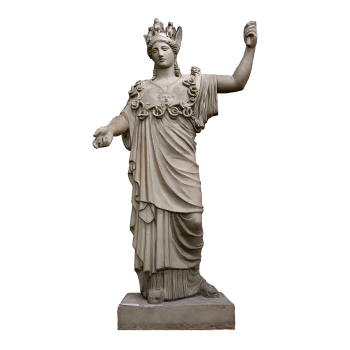
Late Roman period plaster replica statue "Bringing Hope-Athena of Farnese"

Late Roman period plaster replica statue "Bringing Hope-Athena of Farnese"

Bringing Hope-Farnese's Athena is a statue of Asina, a Roman plaster replica of a late 5th century BC Greek original. The design of the statue's intricate helmet was inspired by Asina Parthenon of the Parthenon. The repaired parts include the arms, the animal and cheek pieces on the helmet, and some amulet snakes. The statue has a height of 224cm and is now preserved in the National Museum of Naples.
The Victory Parade after the Battle of Aktime

The Victory Parade after the Battle of Aktime

This marble relief was part of a triumphal parade in Rome to commemorate Octavian's victory at the Battle of Aktim. The Battle of Aktia, a naval battle between the Roman Republic and the Ptolemaic dynasty of Egypt, took place on September 2, 31 BC, and was the last major battle in the Roman Civil War. Roman Commander Agrippa led 400 warships and fought Antony's 500 warships on the west coast of Greece. As a result, Antony's fleet was almost wiped out. The naval battle became the decisive battle of Antony's struggle against Octavian.